Information Visualization, Second Edition: Perception for Design (Interactive Technologies)

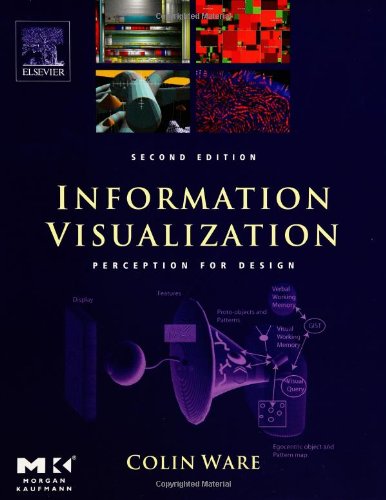
My mother bought Information Visualization, Second Edition: Perception for Design (Interactive Technologies) from my mother websits very happy because it has to ship the product back at home in quick time. After all, we carved Information Visualization, Second Edition: Perception for Design (Interactive Technologies) out of the box. We have found that aspects of it are beautiful. And very
modern. It is not in use. But after we read the beauty of Information Visualization, Second Edition: Perception for Design (Interactive Technologies). Find out the details in the field of very little use. And the use of simple and not confusing. My mother is very old and it can be used without problems. Information Visualization, Second Edition: Perception for Design (Interactive Technologies)
makes our family has enjoyed using it very much. I would recommend Information Visualization, Second Edition: Perception for Design (Interactive Technologies) if you look at the applications close. I would recommend it to you, but what is good. If you still hesitate to say that when you see the price of
it, you hardly feel Information Visualization, Second Edition: Perception for Design (Interactive Technologies). It is appropriate to the property itself.Information Visualization, Second Edition: Perception for Design (Interactive Technologies)

Information Visualization, Second Edition: Perception for Design (Interactive Technologies) Overview
Most designers know that yellow text presented against a blue background reads clearly and easily, but how many can explain why, and what really are the best ways to help others and ourselves clearly see key patterns in a bunch of data?
This book explores the art and science of why we see objects the way we do. Based on the science of perception and vision, the author presents the key principles at work for a wide range of applications--resulting in visualization of improved clarity, utility, and persuasiveness. The book offers practical guidelines that can be applied by anyone: interaction designers, graphic designers of all kinds (including web designers), data miners, and financial analysts.
*First work to use the science of perception to help serious designers and analysts optimize understanding and perception of their data visualizations.
* Major revision of this classic work, with a new chapter on visual thinking, new sections on face perception and flow visualization, and a much expanded chapter on color and color sequences.
*New to this edition is the full color treatment throughout, to better display over 400 illustrations.
Information Visualization, Second Edition: Perception for Design (Interactive Technologies) Specifications
Most designers know that yellow text presented against a blue background reads clearly and easily, but how many can explain why? Information Visualization: Perception for Design explores the art and science of why we see objects the way we do.
Although more technical than most graphic design books, the book "is intended to make [the data from the science and study of visualization] available to the non-specialist." Each chapter focuses on a different facet of human vision, like "Lightness, Brightness, Contrast, and Constancy" in chapter 3, or "Static and Moving Patterns" in chapter 4.
Although the author tries to put a great deal of scientific research data into pedestrian terms, the nature of the subject matter and the papers from which he culls his information make this task an uphill battle from the start. As a result, the book is full of valuable information, but it may not necessarily be right for the average graphic designer looking for a new inspirational spin. Serious interface designers, presentation designers, data analyzers, or any artist tasked with presenting ideas in a visual format, though, should come away from Information Visualization with a clearer understanding of the inner workings of perception. At the very least, they'll be able to explain why yellow text against blue is a good combination. --Mike Caputo
